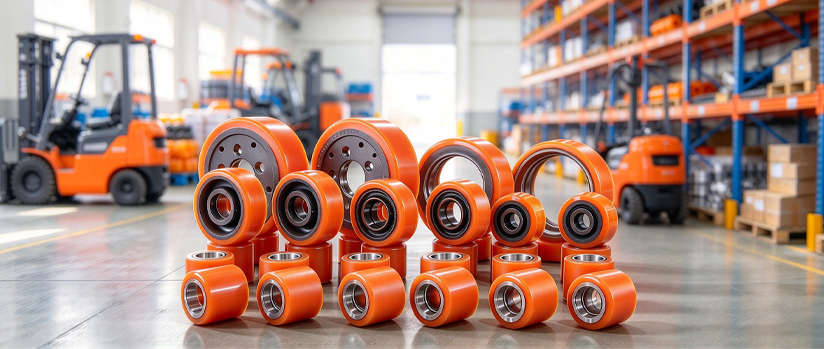
Quick Answer: Polyurethane (PU) drive wheels are generally the preferred choice for electric pallet trucks, stackers and warehouse forklifts operating on smooth indoor floors. Rubber wheels are better suited to applications requiring greater shock absorption, traction and a softer ride. Solid pneumatic-style tires are commonly used on counterbalance forklifts operating on rough outdoor surfaces or mixed indoor-outdoor environments.
The best forklift drive wheel depends on more than its material. Floor conditions, load capacity, operating speed, duty cycle, wheel dimensions and mounting design all affect performance and service life.
Choosing the wrong wheel can lead to premature wear, excessive heat, poor traction, floor damage and unexpected equipment downtime.
This guide compares PU, solid rubber and solid pneumatic tires, explains their applications, and provides a practical checklist for purchasing replacement forklift drive wheels.
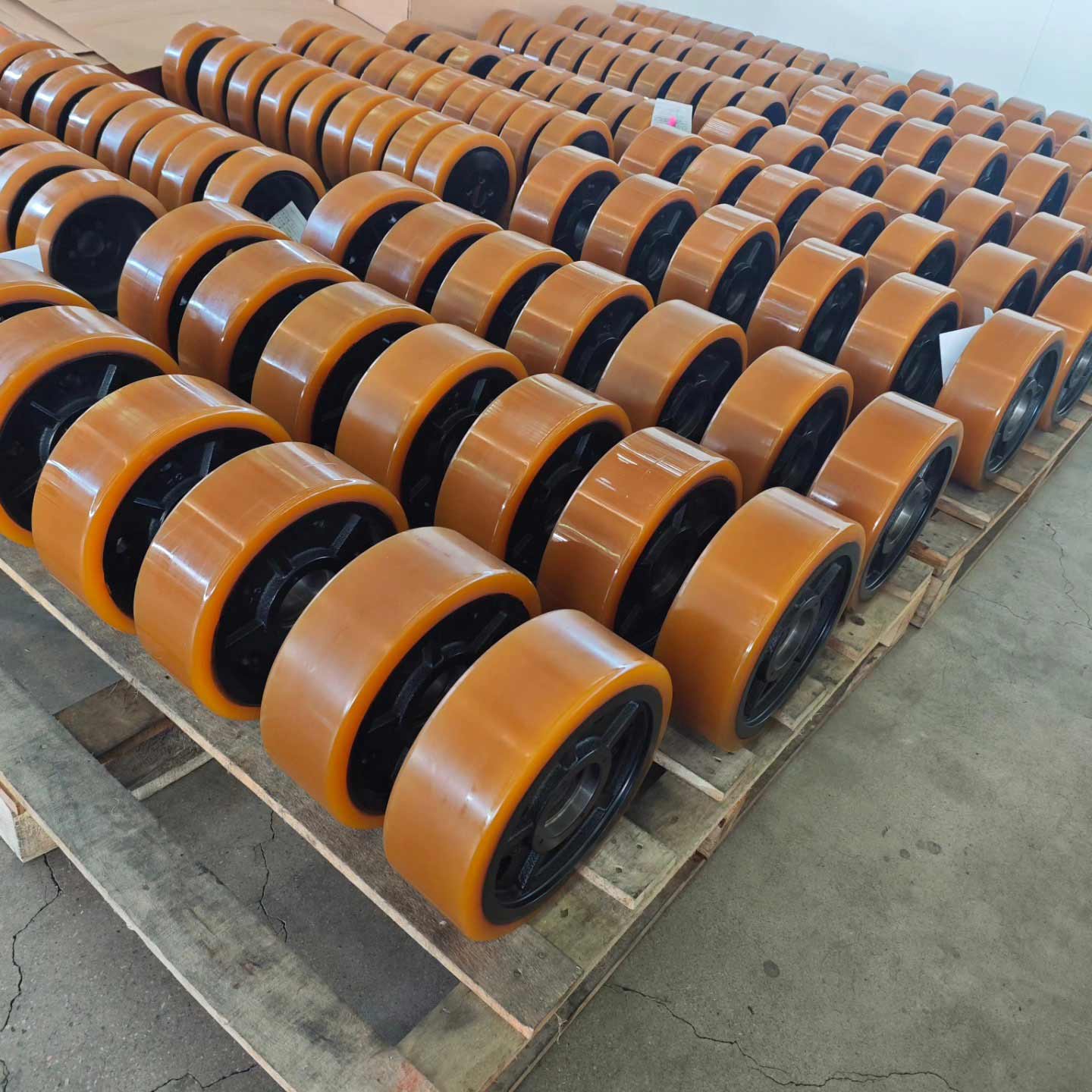
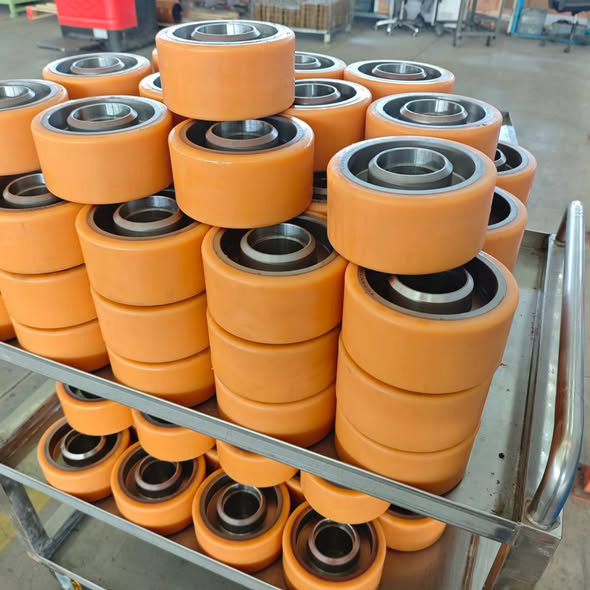
Polyurethane drive wheels typically consist of a PU tread bonded to a steel or cast-iron hub.
They are widely used on electric pallet trucks, stackers, reach trucks and other warehouse material-handling equipment.
Main advantages:
High load-bearing capacity for compact wheel dimensions
Good abrasion and wear resistance
Low rolling resistance with suitable compounds
Good dimensional stability
Non-marking options for clean indoor environments
Typical applications:
Electric pallet trucks
Electric stackers
Reach trucks
Warehouse forklifts
AGVs and other industrial vehicles
Solid rubber wheels are manufactured using rubber compounds molded around a metal core or rim.
Compared with harder polyurethane wheels, rubber generally provides greater elasticity and shock absorption.
Main advantages:
Good traction on various floor surfaces
Better vibration absorption
Comfortable operation
Suitable for applications involving uneven surfaces
Available in different compounds, including non-marking options
Typical applications:
Counterbalance forklifts
Indoor and light outdoor applications
Wet or uneven working environments
Equipment requiring additional shock absorption
Solid pneumatic-style tires have a profile similar to conventional pneumatic tires but use a solid rubber construction without an inflatable air chamber.
They combine a larger tire profile with puncture-resistant construction.
Main advantages:
No inflation or puncture-related downtime
Suitable for rough outdoor surfaces
Better impact absorption than many compact hard wheels
Available for demanding industrial applications
Typical applications:
Outdoor counterbalance forklifts
Construction and industrial yards
Mixed indoor-outdoor operations
Applications involving debris and rough ground
Note: Solid pneumatic-style tires should not be confused with conventional pneumatic tires, which contain an inflatable air chamber.
| Performance Factor | PU Drive Wheels | Solid Rubber Wheels | Solid Pneumatic Tires |
|---|---|---|---|
| Typical hardness | 80–95 Shore A | 60–80 Shore A | Depends on construction |
| Load capacity | Generally high for wheel size | Moderate to high | High, depending on tire size |
| Rolling resistance | Generally low | Medium to high | Medium to high |
| Dry-floor traction | Good | Good to very good | Good |
| Wet-floor traction | Compound and tread dependent | Generally good | Compound and tread dependent |
| Shock absorption | Moderate | Good | Good |
| Wear resistance | Generally excellent | Compound dependent | Application dependent |
| Floor protection | Non-marking grades available | Non-marking grades available | Depends on compound |
| Puncture resistance | Solid construction | Solid construction | Solid construction |
| Typical application | Indoor warehouse equipment | Mixed applications | Outdoor operations |
| Relative cost | Medium | Low to medium | Medium to high |
Important: These are general industry comparisons, not guaranteed specifications. Actual performance depends on the polyurethane or rubber formulation, wheel dimensions, operating conditions and manufacturer's technical data.
The most effective way to select a forklift drive wheel is to start with the working environment rather than the forklift brand.
Recommended: Polyurethane (PU) Drive Wheels
PU wheels are commonly used on electric pallet trucks and stackers operating on smooth concrete, epoxy and polished warehouse floors.
Why choose PU?
Low rolling resistance can help improve energy efficiency.
High wear resistance supports frequent warehouse operation.
Harder compounds provide good load-bearing performance.
Non-marking formulations are available for clean floors.
For example, an electric pallet truck operating throughout a warehouse with smooth concrete flooring is a typical application for a PU drive wheel.
Recommended: Suitable Rubber Compounds or Specialized Traction PU
Rubber wheels generally provide good grip and shock absorption on wet or uneven surfaces.
However, the actual traction performance depends on the compound, tread pattern and floor contamination.
For applications involving water, oil or frequent ramp operation, confirm the wheel's traction characteristics with the manufacturer before purchasing.
Specialized siped PU wheels may also be suitable for certain slippery-floor applications.
Recommended: Solid Pneumatic-Style Tires
Outdoor forklifts frequently encounter:
Rough concrete
Asphalt
Gravel
Floor joints
Small debris
Uneven loading areas
Solid pneumatic-style tires are often preferred for these environments because their larger tire construction provides additional cushioning and resistance to punctures.
They are particularly suitable for counterbalance forklifts working in industrial yards and outdoor logistics areas.
Recommended: Certified Non-Marking Wheel Compounds
Floor contamination is a major concern in facilities with strict cleanliness requirements.
PU wheels are available in non-marking formulations, while rubber wheels can also be manufactured using specialized non-marking compounds.
When purchasing wheels for these environments, confirm:
Non-marking performance
Chemical resistance
Static electricity requirements
Applicable hygiene or facility specifications
Do not assume that every PU or rubber wheel is automatically suitable for clean-room applications.
Hardness is one of the most important parameters when selecting polyurethane forklift wheels.
It is commonly measured using the Shore A durometer scale.
For many industrial PU drive wheels, typical hardness ranges from approximately 80 to 95 Shore A, although the correct value depends on the equipment and application.
Generally offer:
Lower deformation under load
Good dimensional stability
Higher resistance to compression
Efficient rolling on smooth surfaces
However, harder wheels may provide less cushioning and can be less forgiving on uneven floors.
Generally offer:
Better shock absorption
More elastic deformation
Potentially improved contact on certain floor surfaces
However, the actual load capacity, rolling resistance and wear characteristics must be checked.
Purchasing tip: Two PU wheels with the same Shore A hardness can have different wear resistance, rebound resilience, heat generation and bonding performance.
Do not select a drive wheel based on hardness alone. Confirm the compound specification and intended operating conditions.
Different forklift types have different wheel requirements.
| Equipment Type | Common Wheel Choice | Main Selection Considerations |
|---|---|---|
| Electric pallet truck | PU drive wheel | Traction, wear resistance and dimensions |
| Electric stacker | PU drive wheel | Load capacity and operating frequency |
| Reach truck | PU drive and load wheels | Dynamic load, heat and dimensional accuracy |
| Counterbalance forklift | Rubber or solid pneumatic tires | Floor conditions, load and outdoor operation |
| Tow tractor | PU or rubber drive wheels | Continuous operation and traction |
| AGV / AMR | Application-specific PU wheels | Rolling resistance and dimensional consistency |
The original equipment manufacturer's specifications should always take priority over general material recommendations.
For international forklift parts buyers, selecting the correct replacement wheel involves more than identifying its material.
Before requesting a quotation, prepare the following information:
1. Forklift information
Brand
Equipment model
Serial number, if available
2. Existing wheel information
Wheel dimensions
Material
Hardness, if known
Part number or OEM reference
3. Mounting specifications
Bore diameter
Keyway
Bolt pattern
Hub structure
4. Operating conditions
Indoor or outdoor use
Floor material
Maximum load
Daily operating hours
Normal travel speed
5. Purchasing requirements
Required quantity
OEM or aftermarket preference
Standard or customized production
Expected delivery schedule
If the original part number is unavailable, send clear photos of the old wheel, hub and mounting structure.
This information helps the supplier verify the correct replacement and reduce the risk of ordering an incompatible wheel.
Need help identifying a replacement forklift drive wheel?
Send us your forklift model, wheel dimensions, mounting details and application conditions.
Our team will help check the specifications and provide a suitable quotation.
Request a Forklift Drive Wheel Quote
Browse our forklift wheels and tires to find suitable replacement parts for your equipment.
 |
 |
Frequently Asked Questions About Forklift Drive Wheels
Q1. What is the difference between PU and rubber forklift wheels?
PU wheels generally have higher hardness, lower rolling resistance and good wear resistance. Rubber wheels are more elastic and provide better shock absorption in many applications.
PU is commonly used on electric pallet trucks and stackers, while rubber is suitable for applications requiring additional cushioning and traction.
Q2. Are polyurethane forklift wheels better than rubber wheels?
Neither material is universally better.
PU is generally preferred for smooth indoor floors, high-load applications and warehouse equipment.
Rubber is often preferred when shock absorption, noise reduction and traction on uneven surfaces are more important.
The correct choice depends on the equipment and operating environment.
Q3. What does Shore A hardness mean for forklift wheels?
Shore A hardness measures the resistance of an elastomer to indentation.
A higher Shore A value generally indicates a harder material, while a lower value indicates a softer and more flexible compound.
However, hardness alone cannot determine load capacity or service life.
Q4. Can PU drive wheels be used outdoors?
PU wheels can be used in certain outdoor applications, but rough surfaces, debris, moisture and unsuitable operating conditions may reduce traction or accelerate wear.
For regular outdoor operations, evaluate suitable rubber or solid pneumatic-style tires.
Q5. How often should forklift drive wheels be replaced?
There is no universal replacement interval.
Replacement depends on operating hours, load, floor conditions, material, wheel wear and maintenance practices.
Replace wheels when excessive wear, cracks, delamination, deformation or other damage affects safe and stable operation.
Q6. Can I replace only one forklift drive wheel?
It depends on the forklift's drive configuration and the manufacturer's replacement recommendations.
For equipment with paired drive wheels, replacing both wheels may be necessary to maintain consistent diameter, traction and handling.
Always check the original equipment manufacturer's guidance before replacing only one wheel.
Q7. Can forklift drive wheels be customized?
Yes. Many industrial wheel suppliers offer customized solutions based on drawings, samples or existing wheel assemblies.
Customization may include:
Outside diameter and tread width,PU or rubber compound,Shore A hardness,Hub material,Bore and keyway,Bolt pattern
,Special mounting dimensions,Provide the original drawing or sample to confirm feasibility.
Q8. What information should I send when requesting a forklift wheel quotation?
Provide the forklift brand and model, wheel dimensions, material requirements, mounting details and purchasing quantity.
If available, include the OEM part number and photos of the existing wheel.
This allows the supplier to check compatibility and prepare a more accurate quotation.
Obtenez les dernières offres de HUAN XIN Mécanique et Électrique


Envoyez-nous un e-mail
E-mail : simon@lifttops.com
Adresse


 IPv6 réseau pris en charge


 français
 français
 English
 русский
 español
 português
 العربية